
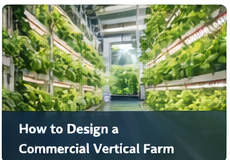
Designing a commercial vertical farm requires a systems approach. It is not just about choosing equipment, but about creating an integrated environment where plant growth, water systems and operating workflows support each other.
Step 1: Define production goals
Start with crop type, target yield and market demand. These parameters influence the system type, plant density and deployment logic.
Step 2: Select the growing system
Typical options include NFT, DWC, aeroponics and vertical tower systems. For scalable commercial use, modular tower systems are attractive because they offer high density, repeatability and easier replication.
Step 3: Design the farm layout
A common commercial model is the farm cell: multiple towers connected to a central irrigation and nutrient system. This supports scaling in repeatable units instead of redesigning every site.
Step 4: Water, nutrients and controls
Commercial performance depends on reservoir design, dosing, recirculation, filtration and monitoring. These systems are the backbone of hydroponic consistency.
See the tower system · View solution architecture · Discuss your project
Move from research to project discussion
Use the RFQ flow if you are evaluating a commercial hydroponic system, greenhouse integration or a farm-cell based pilot deployment.